

Why Traditional ROI Metrics Aren't Enough for Industrial Decisions
When you are managing large industrial projects, you cannot rely only on feeling or simple payback periods. You need clear numbers to back up your decisions. This is where PI (Profitability Index) and the J Factor come in, and this is why understanding PI and J Factor Industrial Projects becomes essential for any manager.
While PI is great for a quick look at the financial returns when you have clear cash flows, it doesn’t tell the whole story. It misses the operational reality. That is why we use the J Factor. It helps you look at the actual operational benefits, like how much you are reducing risk on the floor and whether the project is too complex to execute compared to what it brings.
In this article, we will mention what PI is and how to measure it, what the J Factor is and when to use it, and we will touch real-life industrial examples.
Profitability Index (PI): Calculating Financial Returns in Industrial Settings
Formula:
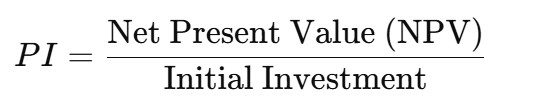
Interpretation:
- PI > 1 → The project makes money.
- PI = 1 → You are at the break-even point. The investment just pays for itself.
- PI < 1 → You are losing money. Walk away.
In large corporations, nobody will look at your project if the PI is just above 1. In my experience, companies usually set a strict threshold of at least 1.2. If your project hits a PI above 1.4, you have a very strong business case that is highly likely to get funded.
Real Industrial Example: Implementing IoT
Imagine an IoT implementation in a food production environment:
- By installing IoT sensors and network infrastructure, a company reduces raw material inventory by 17.6%.
- Lower inventory levels free up working capital, which directly boosts the NPV of the investment.
- If the initial IoT system investment is €200,000 and the expected NPV over five years is €300,000, PI should be 1.5. This means every invested euro generates €1.50 in value — a clear indication of profitability.
J Factor: Evaluating Operational Efficiency and Implementation Complexity
Formula:

Real Industrial Example: Upgrading an Oil Storage Facility
- We calculated the exact total investment needed to replace the pumps.
- We estimated the probability of these pumps failing over their 10-year lifespan.
- We put a price tag on potential losses if they failed (delivery delays, emergency repair costs, and stopping the oil flow to the refinery).
- We multiplied these potential losses by the chance of failure, and divided that by the investment cost.
When to Apply PI and J Factor Industrial Projects
Using PI for Financial Projects
This is your smart tool when a project is driven strictly by money. If you are digitalizing a process to cut for example labor costs or upgrading a line to increase revenue, use PI. It gives you precise calculations because the financial outcomes are easy to track.
Using J Factor for Safety and Reliability Upgrades Projects
Some projects don’t make money directly, but they keep you out of trouble. If you are upgrading safety systems, replacing critical backup equipment, or doing high-complexity engineering changes, use the J Factor. It shows the value of reducing risk and building resilience, even when you can’t see an immediate financial return.
Combined Approach for Complex Projects
Using both metrics together is rare, but it is the best way to handle massive, complex transformations. When a project has both a huge financial impact and a massive operational risk, running both calculations gives management the full picture. You show them the exact financial return and you prove that you have accounted for the operational risks.
Combining PI and J Factor Industrial Projects for Better Decisions
- PI checks if the numbers make financial impact.
- J Factor checks if the project actually makes your plant safer and more efficient without causing a massive headache.
Explore More About Digitalization and Business Transformation
Recommended Reading
How to Measure ROI of Digital Transformation: A Practical Framework
Digital Transformation Metrics That Real Investors Actually Care About
If you want to see how different projects have improved processes, optimized costs, and increased efficiency through digital transformation, visit our digital outcomes section. If you see challenges in your business or would like to discuss different digital solutions, please feel free to visit the contact page.