
Why Digital Maturity Comes Before Digital Transformation
Just like a doctor cannot prescribe treatment without a diagnosis, digital transformation cannot succeed without a clear picture of your current digital maturity level.
If you’re leading a small or mid-sized company and thinking about digitalization, you should ask yourself one critical question before investing in a new CRM, AI solution, or any kind of “smart” system: Where do we stand right now?
Many companies skip this foundational step and then:
- Start projects that are not priorities
- Invest in technologies they’re not ready for
- Waste money, time, and internal trust
Why Leaders Fail Without a Digital Baseline
Without a clear digital baseline, leaders often approve investments based on assumptions rather than facts. This leads to tool overload, fragmented systems, and initiatives that never deliver measurable value. Over time, failed projects erode internal trust and make future transformation efforts even harder to justify.
What Digital Maturity Really Means for Business Leaders
Digital maturity reflects how effectively your organization uses technology to generate business results.
It’s not about the number of software licenses. It’s a multidimensional capability that includes:
- The tools you use
- The processes you’ve automated
- Your team’s digital skills
- The culture of innovation
- The synergy between business and IT
In other words, digital maturity is not a technical measure alone — it’s your company’s ability to adapt and grow through digital means.
Digital Maturity vs Digitalization
Digitalization focuses on adopting tools, while digital maturity reflects an organization’s ability to use those tools effectively. Buying software does not automatically improve performance if processes, skills, and decision-making remain unchanged. True digital maturity is about building sustainable capabilities—not just installing technology.
How to Measure Digital Maturity: Key Dimensions and Assessment Criteria
Measuring digital maturity involves structured assessment across key dimensions. Here’s how:
Digital Maturity Assessment Dimensions
Process Mapping & Digital Touchpoints
Where are your workflows already digitized? Where are Excel sheets, paper forms, or ad-hoc steps still in use?
Technology Infrastructure, Security & Compliance
What tools are in use? Are they integrated? How large is your technical debt? Is there a cybersecurity policy in place? Are you compliant with regulations like NIST or GDPR?
Team Competence
Does your team know how to use the tools? Do they receive training and support? Or are the tools being bypassed?
A reliable digital maturity assessment evaluates multiple dimensions in parallel: business processes, people and skills, technology architecture, data usage, and governance models. Weakness in any one area can limit the impact of all others. That’s why maturity must be assessed holistically, not in isolation.
Why Digital Maturity Is a Business Metric — Not an IT One
Business – IT Alignment
Are there shared goals between IT and business functions? Or does IT procure tools the business never adopts?
Data & Metrics
Are performance, ROI, and KPIs being measured systematically — or left to intuition?
Digital maturity directly affects execution speed, cost efficiency, and return on investment—making it a core business metric. CEOs and CFOs rely on maturity assessments to understand whether the organization can absorb new initiatives without disrupting operations. IT enables maturity, but business leadership owns the outcome.
Digital Maturity Assessment in Practice: A Practical SMB Framework
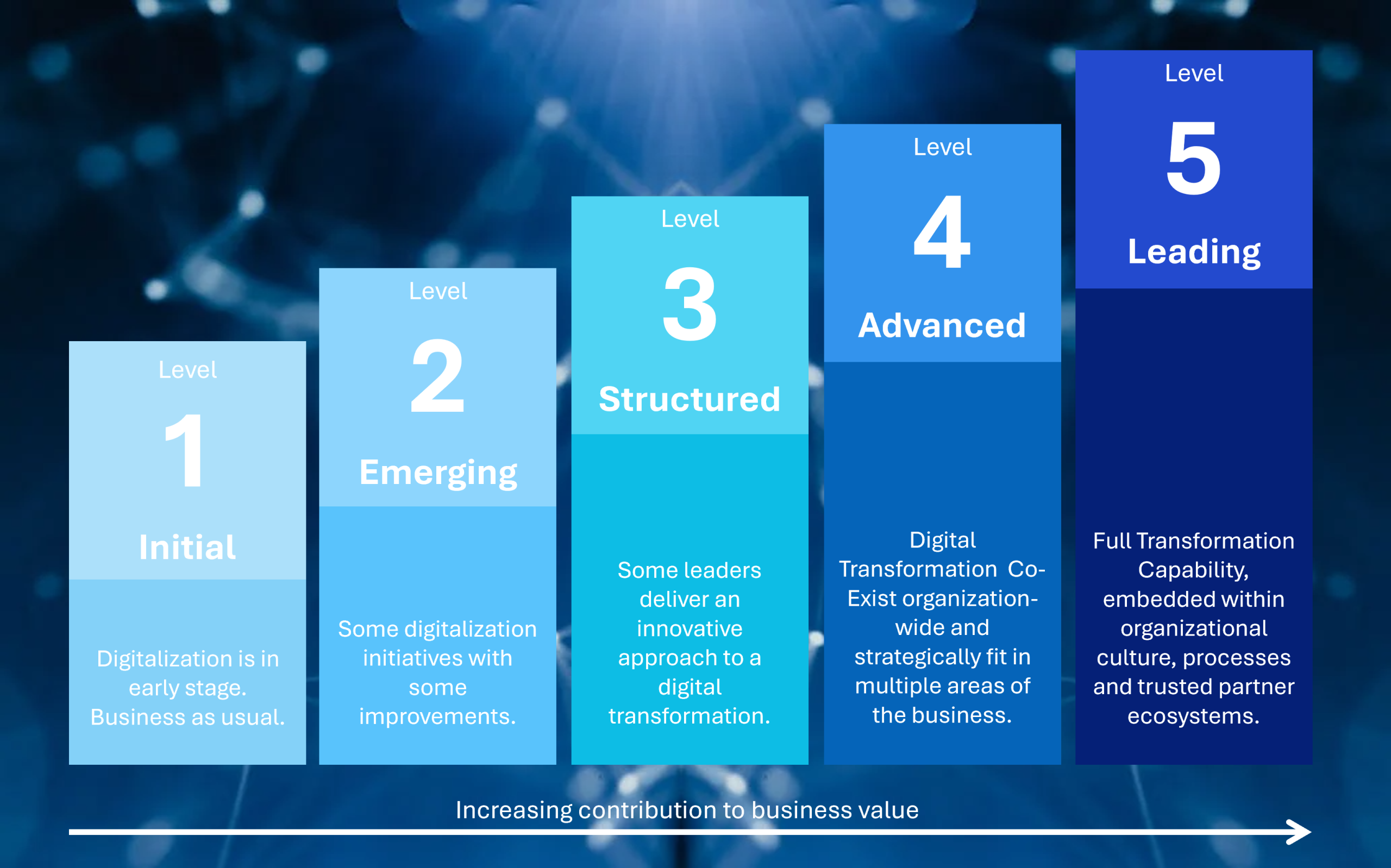
Digital maturity typically evolves across five levels: Initial, Emerging, Structured, Advanced, and Leading. Each level reflects a higher degree of process integration, data-driven decision-making, and organizational alignment. Understanding your current level helps set realistic expectations and prioritize the right next steps. When working as a fractional CTO/CDO with SMBs, I apply a fast but structured method using a 4–5 level maturity model (e.g. Initial, Emerging, Structured, Advanced, Leading), across several categories. For example:
- Are systems connected and automated? Emerging (2/5)
- Are processes there and are there digital workflows? Structured (3/5)
- Do teams use tools as part of their daily work? Initial (1/5)
- Is there a digital roadmap and strategy in place?Emerging (2/5)
Sometimes, we evaluate digital readiness across business initiatives. For example, if a company is considering 30 digital initiatives, we run a multidimensional assessment across each one to derive the aggregate maturity score of the company’s ability to execute them.
The result? A Digital Maturity Scorecard that highlights quick wins and longer-term priorities.
Case Study: Digital Maturity Assessment for an SMB
A company with 80 employees wanted to “start digitalizing.”
What We Found
- They had 4 tools — none were integrated
- Sales used a CRM, but Marketing still used Excel
- No KPIs were defined for digital efforts
What We Did:
- Connected key systems
- Delivered internal training sessions
- Created a 9-month transformation roadmap
Outcome: Measurable ROI and higher operational efficiency within just 6 months.
Common Digital Maturity Assessment Mistakes SMBs Make
Even with the best intentions, many small and mid-sized companies fall into the same traps:
- Starting digitalization without assessing current state
- Focusing only on tools instead of process change
- Relying too heavily on vendors without internal ownership
- Failing to track impact — and not knowing what success even looks like
Why Tools Without Maturity Create Hidden Costs
Implementing tools without sufficient digital maturity often creates hidden costs such as shadow IT, employee resistance, and low adoption rates. Over time, these issues result in sunk investments and operational complexity instead of efficiency gains. Maturity determines whether technology becomes a multiplier—or a burden.
Business Benefits of a Digital Maturity Assessment
- Clarity on where you stand — and why things feel “stuck”
- A realistic roadmap, not guesswork
- Better budget allocation and higher ROI
- Alignment between tech investments and business outcomes
When to Run a Digital Maturity Assessment
- Before investing in a new CRM, ERP, or AI tool
- When leadership says, “we’re not sure what to do next”
- If your team uses tools, but the impact is unclear
- When there’s internal resistance to change
If any of these resonate — it’s time to take a step back and look at the bigger picture.
Explore More About Digitalization and Business Transformation
If you want to see how different projects have improved processes, optimized costs, and increased efficiency through digital transformation, visit our digital outcomes section. If you see challenges in your business or would like to discuss different digital solutions, please feel free to visit the contact page.